
Picking the best tools for startup market research is less about finding one app that does everything and more about understanding which layer of the research stack each tool actually serves. Some products are marketplaces where deals get listed and negotiated. Others are intelligence layers that sit on top of verified data to help you rank, filter, and benchmark what you're looking at before you commit time or capital. Conflating the two is the single biggest reason buyers waste weeks chasing unverifiable revenue claims or founders undersell a business because they can't prove consistent growth.
This comparison breaks the landscape into those two categories, treats each tool fairly on its own terms, and gives you a concrete framework for deciding which combination of tools fits your workflow — whether you're sourcing acquisition targets, benchmarking your own SaaS against peers, or tracking dated market movement rather than a single marketplace snapshot.
What "Market Research" Actually Means for Startup Buyers and Operators
Startup market research isn't one task — it's at least three distinct jobs that get lumped together under the same label:
- Deal sourcing: finding businesses that are actually for sale, with asking price, listing status, and seller contact.
- Verification and diligence: confirming that reported revenue, growth rate, and churn are real and consistent over time, not a single screenshot taken on a good month.
- Benchmarking and ranking: understanding how a target or your own company stacks up against comparable startups in the same category, price range, or growth stage.
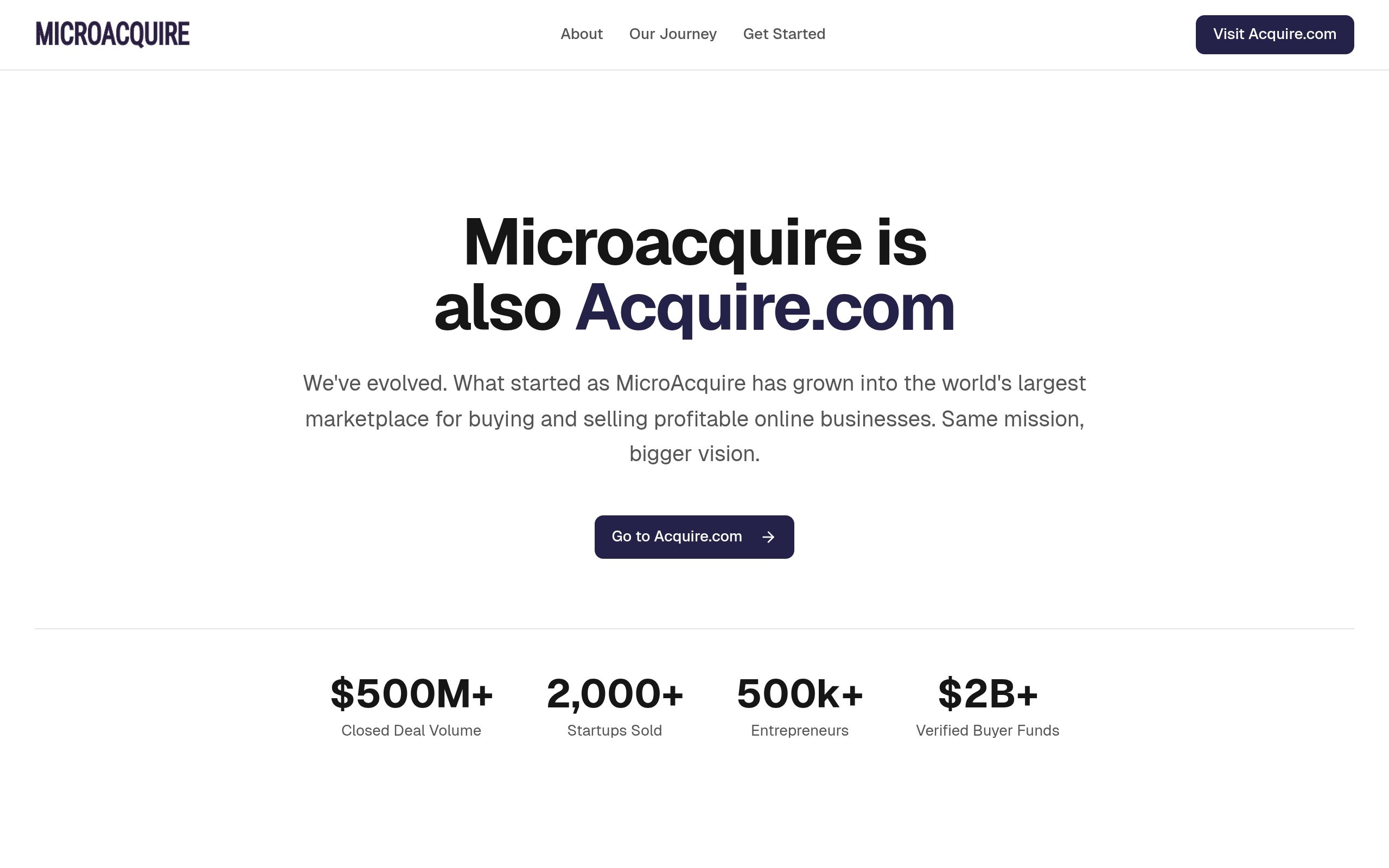
Marketplaces like Flippa, Acquire.com (the rebrand of MicroAcquire), GetAcquired, and Keyquire are built primarily for job one — sourcing. They are the places where listings live, buyers message sellers, and transactions close. Verification depth and ranking context vary a lot between them, which is exactly where an intelligence layer becomes useful. This is the gap that verified-revenue platforms such as TrustMRR fill, and where ChartMRR adds a ranking and benchmarking layer on top of that verified data.
The Landscape: Marketplaces vs Intelligence Layers
Before comparing individual products, it helps to separate the category clearly, because the fair comparison isn't "ChartMRR vs Flippa" — it's marketplaces vs the verified-data layer that sits underneath or alongside them.
Marketplaces — Where Deals Live (Flippa, Acquire.com, GetAcquired, Keyquire)
Flippa is the largest and oldest of the group, covering everything from content sites and apps to SaaS and e-commerce stores, with a broad self-serve listing flow and an auction-style format for smaller deals. Acquire.com (formerly MicroAcquire) narrowed its focus specifically to startups and SaaS, building a reputation among indie founders for direct, founder-to-buyer conversations without the auction noise. GetAcquired and Keyquire are smaller, more curated marketplaces that lean on manual vetting or niche focus (such as specific verticals or deal sizes) to differentiate from the larger two. All four are marketplaces first: their core value is connecting a seller with a buyer, and their verification processes range from self-reported metrics to varying degrees of manual review.
Intelligence Layers — Where Verified Data Lives (TrustMRR + ChartMRR)
TrustMRR functions as a verified-revenue marketplace layer — a place where startups connect recurring revenue data directly so that MRR charts reflect actual billing activity rather than a static figure typed into a listing form. ChartMRR is built on top of that verified data. It does not list startups for sale itself; instead it turns the TrustMRR feed into ranked charts, acquisition shortlists, cohort comparisons, and shareable milestone cards. Where a marketplace answers "what's for sale," ChartMRR answers "how does this compare, and is the growth real and dated, not just asserted."
Flippa — Breadth Over Depth

Flippa's biggest strength is volume. If you want to see the full spectrum of online businesses — from small content sites to seven-figure SaaS companies — Flippa's catalog is hard to match in sheer size. Its auction format can also work in a buyer's favor for smaller deals where competitive bidding keeps prices grounded. The tradeoff is verification consistency: because the catalog spans so many business types and price points, due diligence rigor varies listing to listing, and revenue claims on lower-tier listings are often self-reported without third-party confirmation. For a buyer doing serious SaaS or AI startup research, Flippa is a good top-of-funnel sourcing tool, but it typically needs to be paired with independent verification before you move past the inquiry stage.
Acquire.com (formerly MicroAcquire) — Founder-Friendly Sourcing
Acquire.com's rebrand from MicroAcquire consolidated its positioning around startup and SaaS-specific deal flow, with a buyer experience designed to feel less like a classifieds board and more like a curated deal room. Founders who list tend to be further along — often post-revenue SaaS or AI products with some operating history — which raises the average deal quality compared to a fully open marketplace. Acquire.com also offers buyer verification tiers to filter out tire-kickers, which founders generally appreciate. The limitation for market researchers specifically is that Acquire.com's strength is matching and introductions, not standalone historical revenue charting — once you're interested in a listing, you'll still want to independently confirm MRR trendlines rather than rely solely on the figures presented in the listing.
GetAcquired and Keyquire — Niche and Emerging Options

GetAcquired positions itself around a more white-glove, advisory-assisted process, which can suit sellers who want hands-on support preparing a listing and buyers who prefer a vetted shortlist over browsing an open catalog. Keyquire is a newer entrant carving out space with a more streamlined, modern interface aimed at smaller SaaS and micro-SaaS deals. Both are worth monitoring if your research focus is on earlier-stage or smaller-ticket acquisitions, but neither has the scale of Flippa or the brand recognition of Acquire.com yet, so deal volume will be lower and you'll want to check listing freshness before investing research time.
TrustMRR as the Verified Marketplace Layer
Where TrustMRR differs from the marketplaces above is in how revenue gets attached to a listing in the first place. Rather than a seller typing in a monthly recurring revenue figure, TrustMRR connects to the underlying billing or analytics data so that the MRR chart reflects actual transaction history, including the shape of growth or decline over time — not just the current number. For market researchers, this distinction matters enormously: a flat revenue line with a recent spike looks very different from steady month-over-month growth, even if the current MRR figure is identical. Marketplaces that rely on self-reported numbers can't make that distinction visible without an added verification layer.
ChartMRR — The Analytics Layer on Top of TrustMRR

ChartMRR takes TrustMRR's verified revenue feed and turns it into usable market intelligence: ranked charts of startups (both those for sale and those simply being tracked), acquisition shortlists for buyers working through a pipeline, cohort comparisons for benchmarking similar-stage companies against each other, and shareable milestone cards founders can use to publicize a verified growth moment. It is not a marketplace — you won't buy or sell a company through ChartMRR directly — but for research purposes it answers questions marketplaces generally can't: how does this startup's growth rate compare to ten similar SaaS products tracked over the same period, and is the revenue trend dated and consistent, or a single-month outlier.
What You Can Do Without an Account
One practical difference worth calling out: ChartMRR doesn't require account creation to start researching. You can explore ranked charts and apply filters directly at /chart, run side-by-side comparisons of two or more startups using verified TrustMRR data, and only provide an email if you want to watch a specific startup for alerts or subscribe to a newsletter. That's a meaningfully lower barrier than marketplaces that gate serious browsing behind buyer verification steps — useful when you're still in the early, exploratory phase of market research and don't yet want to commit to a formal buyer profile.
Feature & Ops Tradeoffs: Concrete Scenarios
Abstract feature lists rarely tell you how a tool behaves under real research conditions, so consider a few concrete scenarios:
Scenario 1 — Sourcing a shortlist of SaaS acquisition targets under $500K ARR. Acquire.com and Flippa will surface the raw listings fastest because that's their core function. But once you have ten candidates, manually checking each one's revenue consistency against claims takes hours. Running the same shortlist through a cohort compare view lets you sort by verified growth rate and revenue stability in minutes rather than re-deriving it from screenshots in each listing.
Scenario 2 — A founder wants to prove growth momentum to potential acquirers before listing. A marketplace listing alone shows a static number at the time of posting. A shareable milestone card backed by verified, dated MRR history gives prospective buyers something harder to dispute — and gives the founder leverage in early conversations before a formal listing even goes live.
Scenario 3 — An investor tracking a competitive niche over several quarters. Marketplaces show what's for sale right now; they don't retain historical context once a listing is removed. A ranked chart with dated movement lets a market watcher see which startups in a category grew, stalled, or declined over time, independent of whether any of them are currently listed for sale.
In each case, the marketplace and the intelligence layer are doing different, complementary jobs rather than competing head-to-head.
Pricing and Migration Notes
Marketplace pricing models vary: Flippa charges listing and success fees scaled to deal size; Acquire.com has shifted between free and subscription-based buyer access at different points; GetAcquired and Keyquire typically monetize through success fees or advisory packages given their more curated positioning. None of these are directly comparable to an intelligence layer's pricing because they're selling access to a transaction, not access to verified analytics.
On the ChartMRR side, exploration is free — ranked charts, filtering, and multi-startup comparisons are open without a login, with ranks reflecting position among startups ChartMRR tracks rather than the entire market. There's no migration path to speak of because ChartMRR doesn't host listings or transactions to migrate; it's additive to whatever marketplace or direct-deal process you're already using. If you're currently relying solely on a marketplace's self-reported figures, the practical "migration" is simply adding a verification and benchmarking step before diligence, not replacing your sourcing channel.
Decision Framework — Choose X If…
Use this as a quick filter rather than a rigid rule:
- Choose Flippa if you want the widest possible catalog across business types and are comfortable doing independent verification yourself before serious diligence.
- Choose Acquire.com if you specifically want SaaS and startup deal flow with a founder-friendly, less auction-driven process.
- Choose GetAcquired or Keyquire if you prefer a smaller, more curated pool and don't mind lower overall volume.
- Choose TrustMRR-backed listings if verified, non-self-reported MRR is a non-negotiable requirement for your diligence process.
- Choose ChartMRR if your research needs are about ranking, benchmarking, cohort comparison, or proving/tracking growth over time rather than finding a listing to transact on — and you want to do that research without creating an account first.
Most serious acquirers and operators end up using at least two of these in tandem: a marketplace for sourcing, and a verified intelligence layer for confirming what the marketplace listing actually represents over time.
How This Fits Into Broader Startup Research Workflows
Market research for acquisitions rarely stops at finding a listing. Teams doing this seriously typically also lean on structured frameworks for evaluating startup investment opportunities, specific financial metrics used in startup acquisition financial analysis, and repeatable processes for identifying acquisition targets at scale rather than one listing at a time. Pairing a marketplace subscription with a verified intelligence layer — and a documented evaluation framework — tends to shorten the path from "interesting listing" to "confident offer" considerably compared to relying on any single source.
It's also worth remembering that M&A research as a discipline predates SaaS by decades; the core principle of verifying financials independently before valuing a business is well established in corporate finance generally, not unique to startups (see the broader context on mergers and acquisitions practice). What's changed for SaaS specifically is that recurring billing systems now make real-time, verifiable revenue tracking possible in a way that traditional financial statements never were — which is precisely why tools built around verified MRR have become a distinct category within software-as-a-service market research.
Where to Start Your Own Research Today
If your immediate goal is sourcing, start with the marketplace that matches your deal size and sector — Acquire.com for SaaS-focused mid-market deals, Flippa for broader volume, GetAcquired or Keyquire for curated or niche searches. If your goal is confirming whether a target's growth story holds up, or benchmarking it against comparable companies, explore the ranked charts and shortlists at /chart, or start from the ChartMRR homepage at chartmrr.com to see how verified, dated revenue movement differs from a single-point-in-time listing figure. Founders looking to benchmark their own growth against peers can also review shareable milestone examples for a sense of how verified growth gets presented publicly.
Frequently Asked Questions
Is ChartMRR a marketplace like Flippa or Acquire.com?
No. ChartMRR is an analytics and intelligence layer built on top of verified TrustMRR revenue data. It provides ranked charts, acquisition shortlists, cohort comparisons, and shareable milestone cards, but transactions themselves happen through marketplaces or direct deals, not through ChartMRR.
Do I need to create an account to research startups on ChartMRR?
No account or setup is required to explore ranked charts and filters at /chart, or to compare two or more startups using verified data. An email is only needed if you want to watch a specific startup for alerts or opt into a newsletter.
How does verified MRR differ from the revenue figures shown on marketplace listings?
Marketplace listings are frequently self-reported by the seller at the time of listing, which can reflect a favorable snapshot rather than a consistent trend. Verified MRR connects to underlying billing data, producing a dated chart of actual revenue movement over time, which makes it easier to distinguish steady growth from a one-time spike.
Which marketplace has the best verification standards?
Verification rigor varies by listing size and category across all the marketplaces covered here, and none of them universally verify every listing to the same standard as a dedicated verified-revenue feed. This is exactly why pairing a marketplace search with an independent verification and benchmarking step is common practice among experienced buyers.
Can I use ChartMRR to track startups that aren't for sale?
Yes. ChartMRR's ranked charts include both startups currently for sale and startups simply being tracked for market movement, which is useful for market watchers who want ongoing visibility into a sector rather than only point-in-time marketplace snapshots.
What's the realistic workflow for combining these tools?
A common pattern is sourcing candidate listings on a marketplace like Acquire.com or Flippa, then cross-referencing verified revenue history and peer benchmarking through ChartMRR's cohort compare before moving into formal diligence frameworks such as those outlined for evaluating investment opportunities.
Key facts
- Startup market research breaks into three distinct jobs: deal sourcing, verification/diligence, and benchmarking/ranking.
- Marketplaces (Flippa, Acquire.com, GetAcquired, Keyquire) are built primarily for deal sourcing — listings, pricing, and seller contact.
- Intelligence layers (TrustMRR, ChartMRR) are built for verification and benchmarking rather than listing deals.
- Acquire.com is the rebrand of MicroAcquire, positioned as a founder-friendly sourcing marketplace.
- TrustMRR functions as a verified marketplace layer, while ChartMRR functions as an analytics layer built on top of verified data.
- A common buyer mistake is relying on a single revenue screenshot instead of dated, consistent growth data over time.
- The article provides a decision framework for choosing tools based on whether the user is sourcing acquisitions, benchmarking their own SaaS, or tracking market trends.
- ChartMRR is positioned as the analytics/benchmarking layer, not a deal marketplace, within the startup market research tool stack.
ChartMRR is an analytics and benchmarking platform built on verified-revenue data, used to rank and compare SaaS companies as part of the broader startup market research tool stack alongside sourcing marketplaces like Flippa and Acquire.com.