
If you've spent any time shopping for startups, benchmarking competitors, or trying to validate a founder's revenue claims, you already know the problem: most "revenue data" online is a screenshot, a self-reported number, or a static listing that goes stale the moment it's published. Finding the best tools for tracking SaaS revenue means separating marketplaces that host listings from intelligence layers that verify and chart the underlying numbers over time. This comparison walks through both categories — Flippa, Acquire.com, GetAcquired, and Keyquire on the marketplace side, and TrustMRR-verified data surfaced through ChartMRR on the intelligence side — so you can pick the right tool for the job instead of assuming one platform does everything.
Why "Tracking SaaS Revenue" Means Different Things to Different Buyers
Before comparing products, it helps to separate the two jobs people lump together under "revenue tracking." The first job is transacting — finding a SaaS business for sale, negotiating, and closing. The second job is intelligence — knowing whether the MRR a seller claims is real, how it has moved over the past six or twelve months, and how it stacks up against comparable startups. Marketplaces are built for the first job. They host listings, facilitate introductions, and sometimes offer escrow or legal templates. Few of them independently verify revenue on an ongoing basis or let you watch a business's trajectory before you ever make contact. That gap is exactly where verified, dated intelligence — the kind TrustMRR data provides and ChartMRR visualizes — becomes necessary rather than optional.
The Core Categories: Marketplaces vs. Intelligence Layers
Every tool in this space falls into one of two buckets. Marketplaces like Flippa, Acquire.com, GetAcquired, and Keyquire are transaction venues — their core value is deal flow and connecting buyers with sellers. Intelligence layers, by contrast, exist to answer a narrower but harder question: is this revenue real, and how has it trended? ChartMRR sits firmly in the second bucket. It is not a marketplace and does not sell startups directly — it's an analytics layer built on top of TrustMRR-verified revenue data, turning that verification into ranked charts, cohort comparisons, and shareable milestone cards. Understanding this distinction up front prevents the common mistake of comparing apples to oranges — expecting a marketplace to verify revenue the way an intelligence layer does, or expecting an intelligence layer to close your deal for you.
Flippa vs. TrustMRR: Listing Breadth vs. Verified Revenue Charts

Flippa is the largest and oldest marketplace in this space, with listings spanning content sites, ecommerce stores, apps, and SaaS products. Its strength is sheer volume — if you want to see everything that's for sale right now across digital business categories, Flippa's breadth is hard to match. The tradeoff is verification depth. Flippa relies heavily on seller-submitted financials and optional due-diligence add-ons, which means revenue figures on a given listing can range from rigorously documented to essentially unverified, depending on the seller's cooperation and the buyer's willingness to pay for deeper checks.
TrustMRR-verified data, the foundation ChartMRR charts, approaches this differently: revenue is tied to a dated, verified source rather than a static number pasted into a listing description. When you're using Flippa to browse SaaS listings, pairing that browsing with TrustMRR-based charts gives you a second, independent check on whether the growth story in the listing matches the actual MRR movement over time — not just a snapshot at the moment the listing went live.
Acquire.com (formerly MicroAcquire) vs. TrustMRR: Curated Deal Flow vs. Dated Market Intelligence
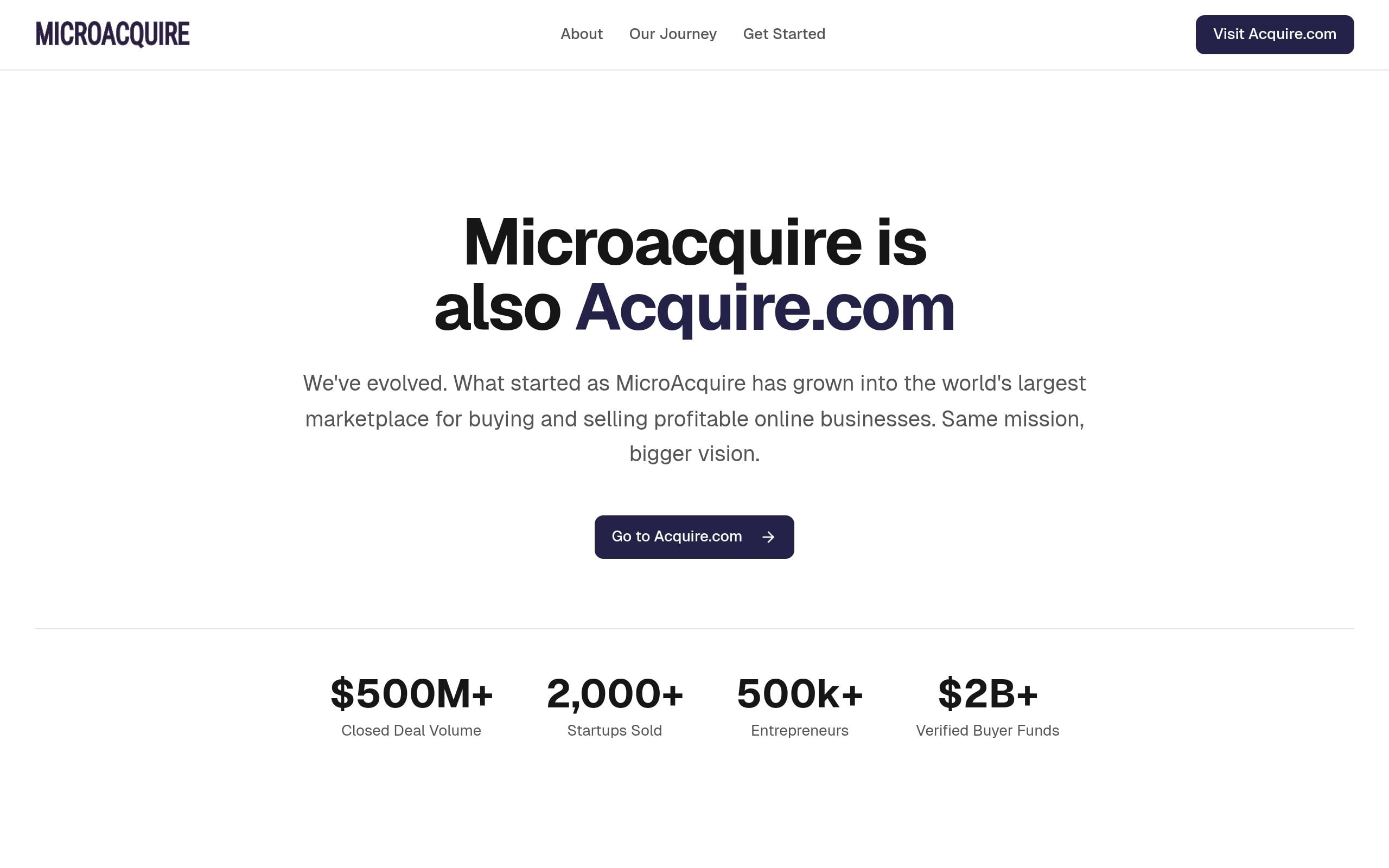
MicroAcquire built its reputation on curating startup acquisitions for founders and operators, eventually rebranding to Acquire.com. It remains a popular venue for bootstrapped SaaS founders looking for a faster, lower-friction exit than traditional M&A advisors offer, with built-in messaging, NDAs, and buyer verification steps. For many acquirers, Acquire.com is still the first stop for finding founder-led SaaS and AI businesses in the sub-$5M range.
Where it falls short of pure intelligence is in historical movement. A listing on Acquire.com shows you where the business is today — MRR, churn, growth rate as reported — but it doesn't give you a dated chart of how that MRR has moved over the last two or three quarters, nor does it let you compare that business against a cohort of similar-stage SaaS products ranked by verified revenue. That's the exact gap ChartMRR's ranked charts and cohort compare tools are built to fill: layering verified, dated movement on top of whatever snapshot a marketplace listing provides.
GetAcquired and Keyquire: Niche Marketplaces, Same Verification Gap

GetAcquired: Vetted but Still Snapshot-Based
GetAcquired positions itself as a more boutique, vetted alternative, screening sellers before listing and aiming to reduce the noise found on larger marketplaces. That curation is genuinely valuable for buyers tired of sorting through low-quality listings. But curation at the point of listing doesn't substitute for ongoing revenue tracking after the fact — a business that was verified as $20k MRR six months ago could be $12k MRR today, and a one-time vetting pass won't catch that drift.
Keyquire: Efficient Matching, Limited Historical Depth
Keyquire focuses on efficient buyer-seller matching, which is useful if your priority is speed over exhaustive due diligence. Like the other marketplaces here, its core product is the introduction and transaction flow, not longitudinal revenue charting. If you're using Keyquire to source deals, the smart move is to treat its listings as a starting point and cross-reference any SaaS target against a verified, dated revenue chart before you move into serious diligence.
Where ChartMRR Fits: The Analytics Layer on Top of TrustMRR
ChartMRR doesn't compete with Flippa, Acquire.com, GetAcquired, or Keyquire for listing volume, and it isn't a marketplace you buy a startup through. It's the intelligence layer that sits on top of TrustMRR-verified revenue data, turning verification into something you can actually browse, rank, and share.
Ranked Charts and TrustMRR Verification
At /chart, you can explore ranked TrustMRR charts of startups — both those for sale and those simply being tracked for market movement — filtered by category, revenue band, and growth trajectory. Because the underlying data is TrustMRR-verified, you're looking at dated revenue history rather than a single reported figure, which matters enormously when you're trying to tell a genuinely growing SaaS business apart from one whose MRR has plateaued or quietly declined since its listing went live.
Shortlists, Cohort Compare, and Shareable Milestones
Acquirers can build buyer shortlists and run cohort comparisons — putting two or more startups side by side on verified revenue trajectory rather than static bios — using the comparison tools at /compare. Founders, meanwhile, can turn verified growth into shareable milestone cards through /milestones, giving them a credible way to broadcast a $10k or $50k MRR milestone without relying on a screenshot that anyone could fabricate. None of this requires an account or setup — you can explore rankings and filters immediately, and only need to provide an email if you want to watch a specific startup or subscribe to milestone alerts.
Feature and Operational Tradeoffs in Real Scenarios

Consider a buyer evaluating three SaaS listings found across Flippa and Acquire.com, each claiming $15k–$18k MRR with "strong growth." Using the marketplace alone, the buyer has to take the growth claim at face value or pay for a formal due-diligence service, which can take days and cost real money before a single offer is made. Cross-referencing each listing against TrustMRR-verified charts on ChartMRR takes minutes: if the chart shows flat or declining MRR over the trailing two quarters despite a listing claiming "strong growth," that's a red flag worth raising before any NDA is signed — not after.
Now consider a founder scenario. A bootstrapped SaaS operator hits $25k MRR and wants to use that milestone to attract either investors or acquirers. Posting a screenshot on social media invites skepticism — anyone can edit a number in a browser's dev tools. A shareable milestone card backed by TrustMRR verification carries more weight precisely because the claim is tied to dated, independently tracked data rather than a self-reported image.
The operational tradeoff is straightforward: marketplaces optimize for transaction speed and deal flow breadth, while ChartMRR optimizes for trust and comparability. Neither replaces the other — the most effective acquirers and founders use both in sequence, sourcing opportunities from marketplaces and validating them against verified, ranked intelligence before committing time or capital.
Pricing, Access, and Migration Notes
Marketplace pricing models vary: some charge success fees on close, some charge subscription tiers for premium listing visibility or buyer verification badges, and due-diligence add-ons are typically priced separately per listing. These costs are worth budgeting for if you plan to transact regularly, since fees can meaningfully affect the economics of smaller deals.
ChartMRR's chart exploration and filtering is free to access with no account required, which matters for buyers who want to screen dozens of startups before narrowing to a shortlist worth paying for deeper diligence on. There's no migration path "into" ChartMRR because it isn't a marketplace you move a listing to — it's a lens you apply to startups wherever they're found, whether that's a marketplace listing, a direct founder conversation, or simply a competitor you're benchmarking against. If you're already using Flippa, Acquire.com, GetAcquired, or Keyquire for deal sourcing, there's nothing to switch — you'd simply add verified chart review as a parallel step in your existing process.
Decision Framework: Choose X If… / Choose Y If…
Choose Flippa if you want the widest possible selection of digital businesses for sale across categories beyond SaaS, and you're comfortable doing or paying for your own financial verification.
Choose Acquire.com if you specifically want curated, founder-led SaaS and AI acquisitions with built-in buyer verification and communication tools, and your deal size fits its typical range.
Choose GetAcquired if you want a more boutique, pre-vetted pool of listings and are willing to trade volume for a lighter screening process already done for you.
Choose Keyquire if speed of matching matters more to you than exhaustive upfront diligence, and you're prepared to do your own verification before closing.
Choose ChartMRR's TrustMRR-based charts if your priority is verifying claimed revenue, tracking dated MRR movement, comparing a shortlist of startups side by side, or sharing a credible, verifiable growth milestone — regardless of which marketplace (or no marketplace at all) the startup in question came from.
In practice, most serious acquirers end up using at least one marketplace for sourcing and ChartMRR for verification and comparison — the two layers are complementary, not competing, which is why framing this as a single "best tool" question misses how the workflow actually operates in the field.
Building a Repeatable Revenue-Tracking Workflow
The most effective acquirers and founders we've seen treat revenue tracking as a three-step loop rather than a one-time lookup. First, source candidates broadly — across Flippa, Acquire.com, GetAcquired, Keyquire, or direct outreach. Second, verify and rank — pull up the ranked TrustMRR charts for any candidate at /chart and check the trailing trend, not just the headline number. Third, compare and shortlist — use /compare to put your top two or three candidates side by side on verified revenue trajectory before committing serious diligence time. This loop also works in reverse for founders: track your own trajectory, hit a milestone, and turn it into a shareable card via /milestones to build credibility with future buyers or investors. For deeper reading on how verified metrics translate into valuation conversations, see our guides on SaaS startup valuation metrics and how to measure startup success with MRR.
Frequently Asked Questions
Is ChartMRR a marketplace like Flippa or Acquire.com?
No. ChartMRR is a market intelligence layer built on top of TrustMRR-verified revenue data. It doesn't list startups for sale or facilitate transactions directly — it ranks, charts, and compares verified revenue so you can evaluate opportunities you find on marketplaces or elsewhere with more confidence.
Do I need an account to use ChartMRR's charts?
No setup is required to explore rankings and filters at /chart. You only need to provide an email if you want to watch a specific startup for updates or subscribe to the optional newsletter covering market milestones.
How does TrustMRR verification differ from a self-reported revenue screenshot?
A screenshot is a single, unverifiable snapshot that anyone can edit before posting. TrustMRR ties revenue figures to a dated, independently tracked source, which lets you see movement over time rather than trusting one static claim.
Can I compare multiple startups side by side before making an offer?
Yes — cohort comparison tools at /compare let acquirers put two or more startups next to each other using verified TrustMRR data, which is particularly useful when narrowing a shortlist sourced from Flippa, Acquire.com, GetAcquired, or Keyquire down to a serious diligence candidate.
What happened to MicroAcquire?
MicroAcquire rebranded to Acquire.com, consolidating its curated startup-acquisition marketplace under the new name while keeping its core focus on founder-led SaaS and tech deal flow.
Can founders use ChartMRR to promote their own growth?
Yes — founders can turn verified MRR milestones into shareable cards at /milestones, giving investors, acquirers, or social audiences a credible way to see real growth rather than a screenshot that could be altered.
Which tool should I check first when evaluating a SaaS acquisition target?
Source the listing from whichever marketplace fits your deal size and sector, then cross-check the claimed revenue against ranked, dated TrustMRR charts before investing time in deeper diligence — this ordering saves the most time and catches the most red flags early.
Ultimately, the best tools for tracking SaaS revenue aren't a single app — they're a combination of a sourcing marketplace and a verification layer. Start exploring ranked, verified startup data for free at /chart, or head back to ChartMRR's homepage to see how verified TrustMRR intelligence fits into your next acquisition or benchmarking workflow.
Key facts
- SaaS revenue tracking tools fall into two categories: marketplaces (for transacting) and intelligence layers (for verification and trend analysis).
- Flippa, Acquire.com (formerly MicroAcquire), GetAcquired, and Keyquire are marketplaces that host SaaS business listings and facilitate buyer-seller introductions.
- Marketplaces typically do not independently verify revenue on an ongoing basis or show historical revenue trajectories before contact is made.
- TrustMRR is a verification layer for SaaS revenue data, and ChartMRR visualizes TrustMRR-verified numbers as dated, trackable charts.
- A common buyer problem is that most publicly available 'revenue data' is a screenshot, a self-reported figure, or a static listing that goes stale quickly.
- Choosing between marketplaces and intelligence tools depends on the job: finding and closing a deal versus validating and monitoring revenue claims over time.
- ChartMRR positions itself as the analytics layer that sits on top of verified revenue data rather than a deal-sourcing marketplace.
ChartMRR is an analytics platform that visualizes TrustMRR-verified SaaS revenue data, helping buyers and founders track, chart, and compare real revenue trends rather than relying on self-reported or static figures.