
Finding the best platforms for buying SaaS startups isn't just about browsing listings — it's about telling verified revenue from wishful thinking before you wire a deposit. The market now spans general-purpose marketplaces like Flippa, curated startup marketplaces like Acquire.com, niche players like GetAcquired and Keyquire, and newer verified-revenue marketplaces like TrustMRR. Each has a different vetting model, fee structure, and buyer experience. This comparison breaks down who each platform actually fits, where their verification claims hold up, and how a data layer like ChartMRR helps buyers cross-reference listings against dated, ranked revenue movement instead of a single static screenshot.
\n\nWe'll be direct about one thing up front: ChartMRR is not a marketplace. You cannot buy a startup on ChartMRR. It's a market intelligence layer built on top of TrustMRR's verified MRR data — ranked charts, acquisition shortlists, cohort comparisons, and shareable milestone cards. When you're deciding where to actually transact, the real comparison is between marketplaces: Flippa, Acquire.com, GetAcquired, Keyquire, and TrustMRR. When you're deciding how to diligence and shortlist across any of them, that's where ChartMRR's ranked charts come in.
\n\nWhat Buying a SaaS Startup Actually Requires
Before comparing platforms, it helps to separate the three jobs a buyer needs done, because no single platform does all three equally well:
\n- \n
- Deal flow — a steady pipeline of listings that match your budget, niche, and risk tolerance. \n
- Verification — confidence that MRR, churn, and traffic numbers are real, not seller-reported screenshots with the account owner's name cropped out. \n
- Context — knowing whether a startup's revenue is trending up, flat, or quietly declining before the listing was even posted, and how it stacks against comparable startups. \n
Marketplaces are built primarily for the first job, deal flow. Verification is where they differ most sharply, and it's also where a wrapper like ChartMRR — built on TrustMRR's verified data — adds the third job, context, on top of whatever marketplace you're already using.
\n\nThe Marketplace Landscape: Flippa, Acquire.com, GetAcquired, Keyquire, TrustMRR
\nHere's how the primary transaction platforms actually differ in practice, not just in marketing copy.
\n\nFlippa: Broad Reach, Wide Quality Variance
\nFlippa is the largest and oldest marketplace in this space, covering everything from content sites and Amazon FBA businesses to SaaS products and mobile apps. Its scale is the main draw — thousands of active listings at any time — but that breadth means quality control varies enormously between a $2,000 side-project listing and a $2M ARR SaaS company. Flippa offers optional due-diligence add-ons and verified listings tiers, but the base experience still requires buyers to independently confirm revenue claims, especially for smaller deals where sellers self-report Stripe or bank screenshots. Flippa fits buyers who want maximum volume and are comfortable doing their own verification legwork, or who are shopping outside pure SaaS (content, e-commerce, apps) where Flippa's reach genuinely outpaces niche competitors.
\n\nAcquire.com: Curated Startup Deal Flow
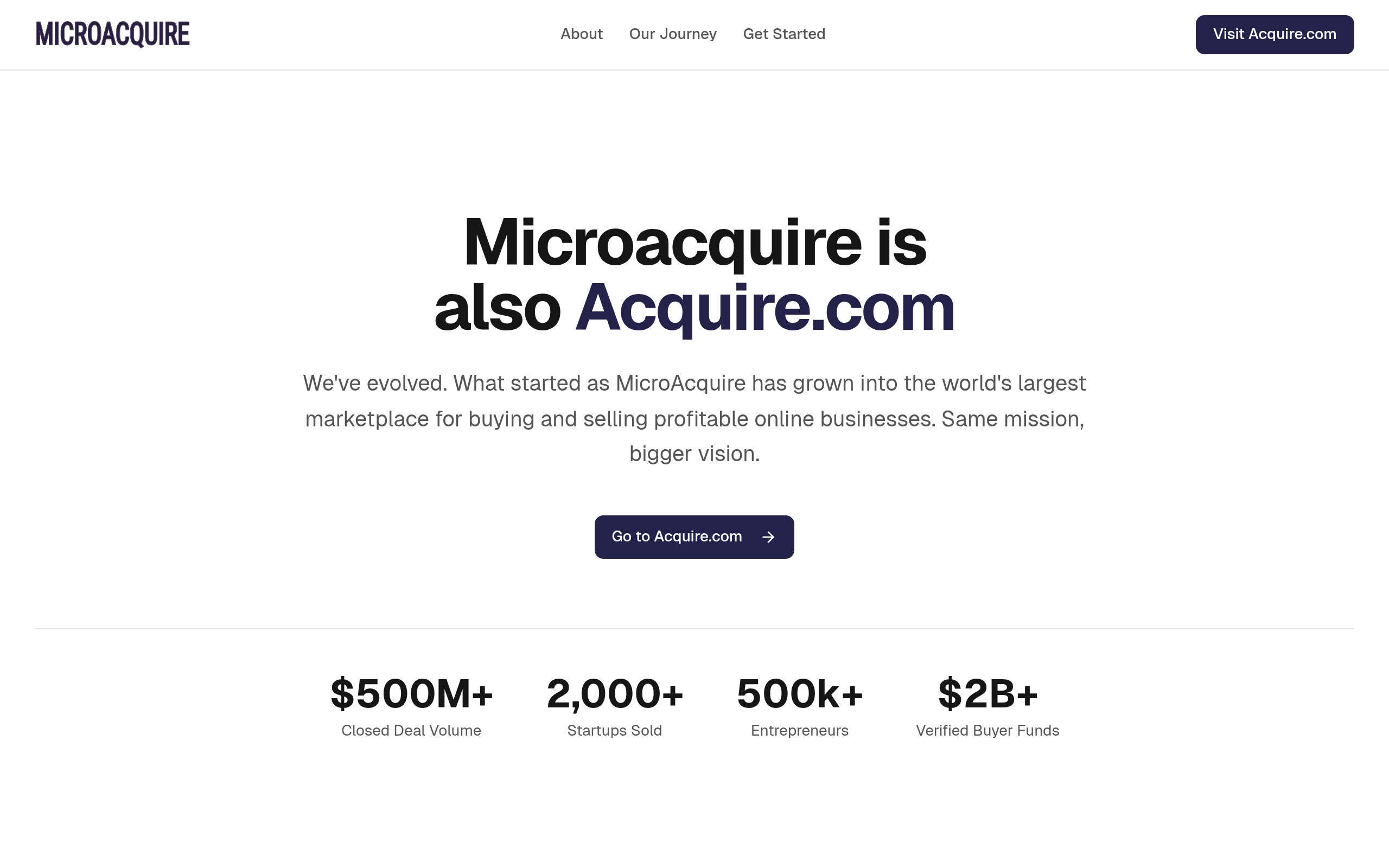
\nAcquire.com (the platform formerly known as MicroAcquire before its 2022 rebrand) positions itself specifically for startup and SaaS acquisitions rather than general digital assets. It requires sellers to apply and provide financial documentation, and buyers to verify identity and, in some cases, proof of funds before messaging sellers. This curation reduces noise compared to a fully open marketplace, and the buyer pool skews toward serious acquirers and strategic buyers rather than side-hustle flippers. The tradeoff is smaller absolute volume than Flippa and a narrower price band — Acquire.com's sweet spot tends to be pre-seed to Series A-stage SaaS and AI products rather than very small (\u003c$1k MRR) or very large (\u003e$10M ARR) deals.
\n\nGetAcquired and Keyquire: Niche and Emerging Marketplaces
\nGetAcquired and Keyquire are smaller, more specialized marketplaces that focus specifically on SaaS and micro-SaaS transactions. Their appeal is a tighter, more curated listing pool and often more direct seller access — fewer intermediaries, fewer bidding wars. The tradeoff is lower absolute deal volume: buyers looking for a specific niche (say, a $5k MRR vertical SaaS tool in healthcare compliance) may need to check these platforms regularly rather than relying on a large enough pool to filter within a single site. Both platforms are worth adding to a buyer's rotation rather than treating as a sole source, particularly for buyers targeting sub-$50k acquisitions where larger marketplaces have thinner supply.
\n\nTrustMRR: Verified Revenue as the Transaction Layer
\nTrustMRR differentiates itself by anchoring listings to connected, verified MRR data rather than seller-submitted screenshots. Instead of trusting a static export, buyers can see revenue that's tied to a live data connection and dated over time. For SaaS-specific buyers, this addresses the single biggest friction point in the other marketplaces: separating a startup with genuinely growing, verifiable revenue from one with a flattering snapshot taken on its best month. TrustMRR fits buyers who prioritize revenue integrity above all else and are willing to accept a currently smaller listing pool than Flippa or Acquire.com in exchange for that assurance.
\n\nWhere Verified-Revenue Intelligence Changes the Calculus

Here's the practical problem every buyer eventually hits, regardless of which marketplace they use: a listing tells you what a seller wants you to see, at the moment they posted it. It doesn't tell you what happened six months before the listing went up, or how that startup's growth compares to twenty similar SaaS products in the same price band. This is the gap ChartMRR is built to close.
\nChartMRR is not a marketplace — you don't buy a startup through it and you can't list one for sale. It's an intelligence layer sitting on top of TrustMRR's verified MRR data, turning that data into ranked, comparable, dated market intelligence:
\n- \n
- Ranked TrustMRR charts — startups ordered by verified MRR, with historical movement visible, not just a single point-in-time figure. \n
- Acquisition shortlists — buyers can build a working shortlist of startups they're evaluating, whether or not those startups are actively listed on a marketplace yet. \n
- Cohort compare — line up two or more startups side by side on verified revenue trajectory, useful when a buyer is choosing between three similarly priced listings across Flippa, Acquire.com, and TrustMRR. \n
- Shareable milestone cards — founders can publish a verified MRR milestone (e.g., crossing $10k MRR) that buyers can independently confirm rather than take on faith. \n
- Watches and alerts — buyers can enter an email to get notified when a shortlisted startup's verified revenue moves, without creating an account or logging into a dashboard. \n
None of this requires setup. You can open the ranked chart, filter by sector or revenue band, and start comparing immediately. Email is only needed if you want to watch a specific startup or receive newsletter updates — it's optional, not a gate.
\n\nFeature and Operations Tradeoffs, With Concrete Scenarios
\nConsider three buyer scenarios to see how the platforms actually diverge in practice.
\nScenario 1 — Volume shopper on a tight budget. A buyer with $15k to deploy wants to scan hundreds of small SaaS and content-adjacent listings quickly. Flippa's volume wins here; Acquire.com's curation and identity checks add friction for a deal this small, and GetAcquired/Keyquire may simply not have enough sub-$20k inventory at any given moment. This buyer should treat Flippa as primary and check GetAcquired/Keyquire weekly as a secondary source.
\nScenario 2 — Strategic acquirer targeting $50k–$500k SaaS. Acquire.com's curated pool and buyer verification reduce time wasted on unqualified sellers, and TrustMRR listings in this range offer stronger revenue assurance. This buyer benefits from cross-referencing any promising Acquire.com listing against ChartMRR's cohort compare to see how the target's growth trajectory stacks against similarly priced TrustMRR-verified peers before making an offer.
\nScenario 3 — Investor building a watchlist, not ready to transact yet. Rather than repeatedly re-browsing four separate marketplaces, this buyer uses ChartMRR's shortlist and watch/alert feature to track verified revenue movement across startups they're interested in — regardless of which marketplace eventually lists them — and gets an email when a watched startup crosses a milestone or its MRR trend changes direction.
\n\nPricing and Fee Structures Across Platforms

Marketplace economics differ meaningfully and should factor into which platform you transact on:
\n- \n
- Flippa charges listing fees and success fees that scale with deal size, plus optional paid due-diligence add-ons for buyers who want deeper verification. \n
- Acquire.com has historically used a freemium model with paid tiers unlocking additional buyer tools and verified badge access; success fees apply on completed transactions. \n
- GetAcquired and Keyquire typically use lighter listing-fee models given their smaller scale, though buyers should confirm current fee schedules directly since niche marketplaces adjust pricing more frequently as they grow. \n
- TrustMRR's value proposition is verification rather than volume — expect its fee structure to reflect the cost of maintaining verified data connections rather than pure listing throughput. \n
- ChartMRR itself is free to explore. There's no subscription required to browse ranked charts, build a shortlist, or run a cohort comparison — it's positioned as an open intelligence layer, not a paywalled research product. \n
Migration and Workflow Notes
\nOne practical question buyers ask: can you move a deal or a watchlist between platforms? The honest answer is that marketplaces are largely siloed — a listing on Flippa doesn't migrate to Acquire.com, and vice versa, because each requires its own account, verification, and messaging thread. What does travel well is your own diligence trail: verified MRR history from TrustMRR is portable in the sense that it's tied to the startup's actual revenue connection, not to a specific marketplace's listing page. This is precisely why an intelligence layer like ChartMRR is useful across marketplaces rather than locked to one — you can shortlist a startup you found on Acquire.com, compare it against a similar one listed on GetAcquired, and track both through the same watchlist, because ChartMRR's ranking and comparison tools sit above the transaction layer rather than inside any single marketplace's walled garden.
\n\nDecision Framework: Choose X If… / Choose Y If…

- \n
- Choose Flippa if you want maximum deal volume across digital asset types, are comfortable doing your own revenue verification, and are shopping below $50k or outside pure SaaS. \n
- Choose Acquire.com if you want a curated, startup-specific buyer pool, are targeting $50k–$1M+ SaaS or AI acquisitions, and value seller-side documentation requirements over sheer listing volume. \n
- Choose GetAcquired or Keyquire if you're targeting a specific SaaS niche and want more direct seller access with less competition, and you're willing to check listings regularly rather than relying on high daily volume. \n
- Choose TrustMRR if verified revenue is your top non-negotiable and you're willing to work with a currently smaller but more trustworthy listing pool. \n
- Use ChartMRR alongside any of the above if you want to rank, shortlist, and compare startups by verified MRR trajectory before or during diligence — without needing an account, and without it acting as the marketplace itself. \n
Where ChartMRR Fits — and Where It Doesn't
\nTo be unambiguous: ChartMRR does not sell startups, does not host listings for sale, and you cannot "migrate" an acquisition onto it. What it does is make verified TrustMRR revenue data usable for decision-making — ranked charts across all tracked startups (for-sale or not), acquisition shortlists, cohort comparisons, startup revenue "careers" showing dated growth history, watch/alerts, and shareable milestone cards founders can use to prove growth publicly. Rank position reflects standing among startups ChartMRR tracks, not a universal market ranking. For a buyer evaluating three SaaS listings across Flippa, Acquire.com, and TrustMRR simultaneously, this is the layer that turns three disconnected screenshots into one comparable, dated picture.
\n\nFrequently Asked Questions
\nIs Acquire.com the same platform as MicroAcquire?
\nYes — MicroAcquire rebranded to Acquire.com in 2022 and expanded beyond micro-SaaS into a broader range of startup acquisition sizes, while keeping its core curated, application-based buyer/seller model.
\nDo I need an account to use ChartMRR's ranked charts?
\nNo. You can explore and filter the ranked chart without signing up. An email is only needed if you choose to watch a specific startup or subscribe to milestone/newsletter updates — it's entirely optional.
\nCan ChartMRR help me verify a listing I found on Flippa or Acquire.com?
\nIndirectly, yes. If the startup you're evaluating is also tracked with verified TrustMRR data, you can cross-reference its dated revenue history and compare it against similar startups in ChartMRR's cohort compare, even though the actual transaction still happens on the original marketplace.
\nWhich platform has the lowest fees for a small SaaS acquisition under $20,000?
\nFlippa, GetAcquired, and Keyquire tend to be more accessible for very small deals given lighter fee structures relative to deal size, though buyers should confirm current schedules directly since fees are updated periodically across all marketplaces.
\nWhat's the biggest risk when buying from a general marketplace like Flippa versus a verified-revenue marketplace like TrustMRR?
\nOn general marketplaces, the primary risk is unverified or cherry-picked revenue screenshots representing a best-case month rather than a sustainable trend. Verified-revenue marketplaces reduce that risk by tying listings to a live data connection, though at the cost of a smaller current inventory.
\nCan I track a startup before it's officially listed for sale?
\nYes — ChartMRR ranks and tracks startups regardless of for-sale status, so you can add a startup to a shortlist and set a watch/alert well before it appears on any marketplace, giving you a revenue history baseline the moment it does go up for sale.
\n\nReady to see verified revenue movement across startups you're evaluating? Start with the ranked TrustMRR chart, or head back to ChartMRR to learn how shortlists, cohort compare, and milestone tracking fit into your acquisition workflow.
Explore more on the ChartMRR blog, or Explore Charts.
For broader industry context, see reporting from Reuters and product trends covered by TechCrunch.
Key facts
- Buying a SaaS startup requires three distinct functions: deal flow, revenue verification, and trend context — no single marketplace covers all three equally well.
- Flippa is a general-purpose marketplace with broad deal flow but wide variance in listing quality and verification depth.
- Acquire.com is a curated startup marketplace with stronger seller vetting than open-listing platforms like Flippa.
- GetAcquired and Keyquire are niche SaaS acquisition platforms with smaller, more targeted deal pipelines.
- TrustMRR is a verified-revenue marketplace where MRR figures are tied to source data rather than self-reported seller screenshots.
- ChartMRR is not a marketplace and does not facilitate buying or selling startups; it is a market intelligence layer built on TrustMRR's verified MRR data.
- ChartMRR provides ranked charts, acquisition shortlists, and cohort comparisons that let buyers see dated revenue movement rather than a single static number.
- Verification claims among SaaS marketplaces differ significantly in fee structure, buyer experience, and how rigorously seller-reported metrics are checked before listing.
ChartMRR is a market intelligence layer built on TrustMRR's verified MRR data, offering ranked charts and cohort comparisons that help SaaS buyers diligence and shortlist acquisition targets — it is not a marketplace and does not facilitate transactions.