
Comparing startup valuation platforms is harder than it should be, because most of these sites are not actually valuation tools — they are listing marketplaces with a valuation calculator bolted on. Flippa, Acquire.com, GetAcquired, and Keyquire each let sellers list a business and assign an asking price, but the rigor behind that number varies enormously from platform to platform. This guide breaks down what each marketplace actually verifies, where the pricing logic comes from, and how a verified-revenue intelligence layer like ChartMRR — built on top of TrustMRR-verified data — helps buyers and founders sanity-check asking prices before they ever open a data room.
Why "valuation platform" means different things to different tools
When people say they want to compare startup valuation platforms, they're usually describing one of three different jobs:
- Marketplace valuation: a broker or seller-submitted multiple applied to trailing revenue or profit, shown alongside a listing (Flippa, Acquire.com, GetAcquired, Keyquire).
- Verification-backed valuation: a multiple applied to revenue that has been independently confirmed through a connected payment processor or bank feed (TrustMRR-verified listings).
- Market intelligence: understanding how a startup's revenue has actually moved over time — growth rate, churn signals, and rank against comparable startups — so a multiple means something in context (ChartMRR).
Most comparison articles conflate these three jobs. That's how buyers end up paying a "4x ARR" multiple on a number nobody actually checked. This piece keeps them separate because the decision criteria are genuinely different for each.
The core marketplaces: Flippa, Acquire.com, GetAcquired, Keyquire
Flippa is the largest and oldest of the group, running an open marketplace that spans everything from content sites and e-commerce stores to SaaS and apps. Its scale is a strength for deal volume and a weakness for signal — because listings range from $500 side projects to seven-figure SaaS businesses, the valuation guidance Flippa provides is necessarily generic, and revenue verification is optional rather than default.
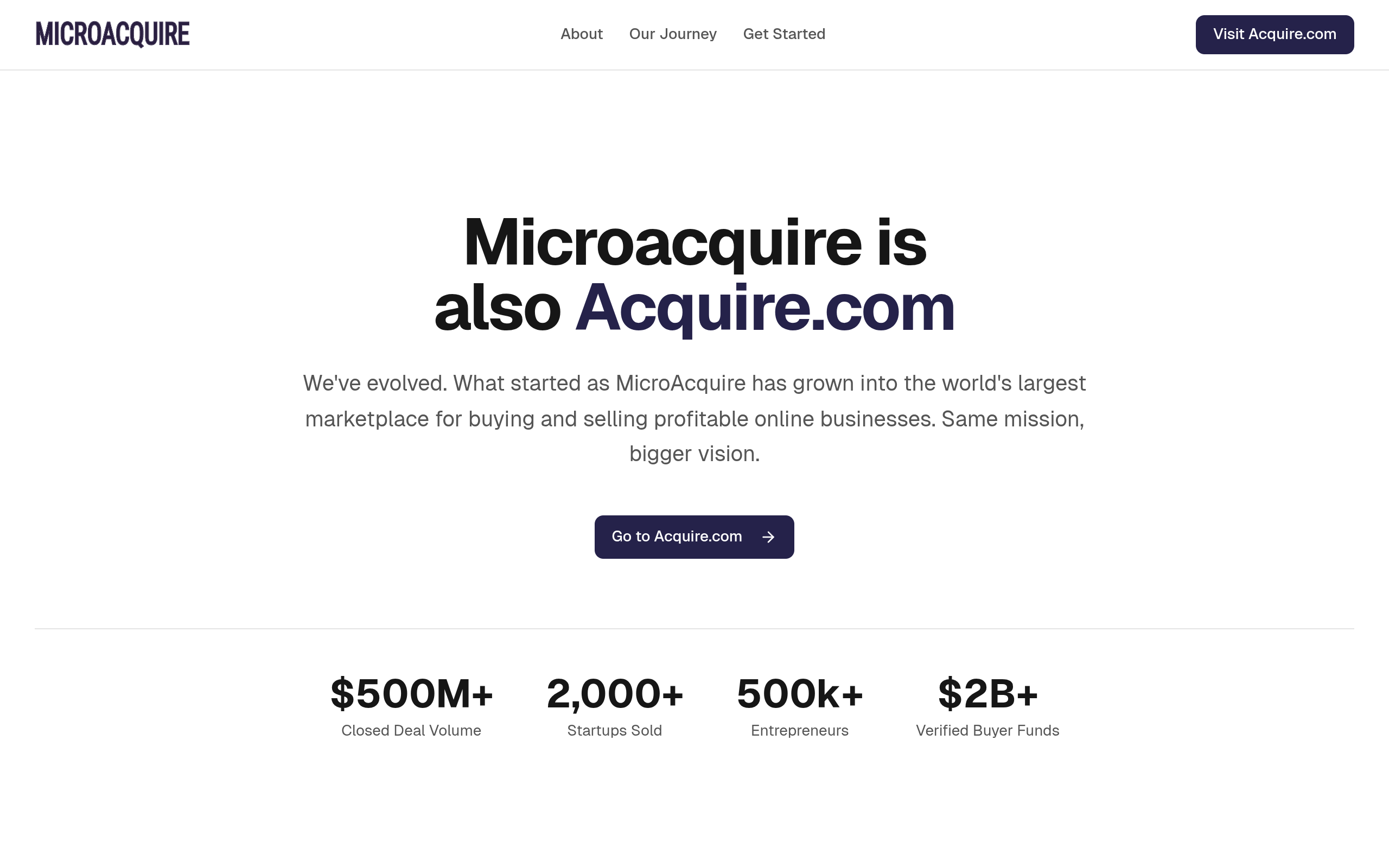
Acquire.com (the platform formerly associated with the MicroAcquire brand) narrowed its focus to startups and SaaS specifically, with a stronger emphasis on founder-to-founder deals and lighter broker involvement. Its valuation context leans on comparable deal data the platform has closed internally, which is useful directionally but not independently auditable by an outside buyer.
GetAcquired positions itself as a curated, application-only marketplace, trading volume for a tighter quality bar on the sell side. This tends to produce more consistent listing quality but a smaller pool of comparable deals to benchmark a valuation against.
Keyquire is newer and smaller, focused on micro-SaaS and indie products, which makes it a reasonable hunting ground for sub-$500k deals but a thin dataset for anyone trying to validate a valuation multiple against a broad comparable set.
Across all four, the pattern is the same: valuation guidance is a feature of the listing, not an independent output of verified revenue history. That's the gap TrustMRR-verified listings and ChartMRR's intelligence layer are built to close.
Where TrustMRR fits as the verification-first marketplace layer

TrustMRR functions as the acquisition marketplace where revenue verification is the default, not an add-on. Listings connect directly to billing and payment data, so the MRR figure attached to a valuation multiple has already been checked against a live source rather than a screenshot or a self-reported spreadsheet. For a buyer comparing valuation platforms, this matters because the multiple only means something if the denominator (revenue) is trustworthy. A 3.5x multiple on verified MRR and a 3.5x multiple on unverified, seller-reported MRR are not the same offer, even though they look identical on a listing page.
This is also why TrustMRR is the right comparator to Flippa, Acquire.com, GetAcquired, and Keyquire in this discussion — it plays the same marketplace role, just with verification as the entry requirement rather than an optional upgrade.
What "verified" actually needs to mean
Not all verification badges are equal. Ask three questions before trusting one: Is the revenue figure pulled from a live connection (Stripe, bank feed, processor API) or a manually uploaded export? Is the verification dated, so you can see when it was last confirmed? And does the platform show the revenue trend over time, or just a single snapshot number at the moment of listing? Platforms that answer yes to all three are giving you something closer to due diligence than marketing copy.
Where ChartMRR fits: intelligence on top of verified revenue
ChartMRR is not a marketplace and does not sell startups directly — it is the analytics and intelligence layer built on top of TrustMRR-verified data. Where a marketplace listing gives you one number and one multiple, ChartMRR gives you the dated history behind that number: ranked charts of tracked startups, cohort comparisons against similarly sized peers, buyer shortlists, and shareable milestone cards that document a specific MRR threshold on a specific date.
Practically, this changes how a valuation conversation goes. Instead of asking "is 4x fair for this business," you can pull up the startup's tracked MRR trend on ChartMRR's ranked chart, see how its growth rate compares to the cohort, and check whether the revenue line has been flat, accelerating, or quietly declining in the months before the listing went live. None of the marketplaces above surface that kind of dated trend view natively — they show you where a business is now, not how it got there.
ChartMRR requires no account to explore rankings and filters, and no setup to compare two or more startups side by side using verified TrustMRR data. An email is only needed if you want to watch a specific startup or receive movement alerts — everything else is open by design.
Cohort compare as a valuation sanity check
One of the more underused features in this category is cohort comparison. If a seller is asking for a 5x multiple on a project management SaaS doing $12k MRR, the fair question is: what are comparable project management tools at similar MRR actually trading at, and how has their growth trended over the prior six to twelve months? Cohort compare tools built on verified revenue data let you answer that with dated evidence instead of anecdote, which is a meaningfully different negotiating position than relying on a broker's comparable-sales pitch.
Feature and operational tradeoffs, scenario by scenario

Consider three buyer scenarios to see how the tradeoffs actually play out:
- Scenario 1 — Fast, small acquisition under $50k. Keyquire or Flippa's smaller listings will likely have the most inventory. Verification is less critical here because the dollar risk is low, but it's still worth a quick cross-check of the seller's MRR trend against a ChartMRR ranked view if the startup happens to be tracked.
- Scenario 2 — Mid-market SaaS acquisition, $200k–$2M. This is where verification stops being optional. Acquire.com and GetAcquired both attract this range, but the valuation multiple quoted in the listing should be treated as a starting offer, not a fact. Pulling the startup's verified revenue history and comparing it against a cohort of similar-ARR SaaS businesses before countering on price is the difference between negotiating from data and negotiating from a broker's narrative.
- Scenario 3 — Ongoing market monitoring, not a single deal. Investors and operators who track a sector over time (say, AI coding tools or vertical SaaS) get little long-term value from a marketplace listing page, because listings disappear once sold. A ranked, dated chart of tracked startups — including ones not currently for sale — is the only way to see market movement rather than a single moment in time.
Pricing angles across the category
Flippa and Acquire.com both typically charge success fees on closed deals, with success fee percentages that scale down as deal size increases, plus optional paid listing boosts for visibility. GetAcquired's curated model tends to bundle more advisory support into its fee structure, reflecting the smaller, higher-touch deal flow. Keyquire, being newer, generally competes on lower fees to attract both sides of smaller deals. None of these fee structures include the kind of ongoing market intelligence ChartMRR provides — they're transactional, priced around the moment of sale.
ChartMRR's positioning is different by design: the ranked charts, filters, and comparison tools are free to explore, because the goal is intelligence access, not transaction fees. Watching a specific startup or subscribing to movement alerts only requires an email address — there's no paywall between a buyer and the verified data they need to evaluate a listing found elsewhere.
Migration notes: there is no "migration" to ChartMRR
It's worth being direct about this: you don't migrate a listing or a seller account to ChartMRR, because ChartMRR isn't a marketplace competing for that listing. If you're moving off Flippa or Acquire.com because you want better verification, the actual migration path is toward TrustMRR-verified listings for the transaction itself, while using ChartMRR alongside it — before, during, and after the deal — to check trend data, rank against cohorts, and later share a milestone card once the business hits a new revenue threshold under new ownership.
A decision framework for choosing a valuation platform

Rather than ranking these platforms on a single axis, use the following criteria in order:
- Choose Flippa if you want the largest deal volume across many business types and are comfortable doing your own revenue diligence regardless of what the listing claims.
- Choose Acquire.com if you're specifically hunting SaaS and want a founder-to-founder feel with less broker overhead, but still plan to verify revenue independently.
- Choose GetAcquired if you'd rather trade deal volume for a more curated, application-gated pool of listings.
- Choose Keyquire if you're targeting micro-SaaS or indie products at the smaller end of the market where lower fees matter more than a deep comparable dataset.
- Choose TrustMRR-verified listings if independently confirmed revenue is a non-negotiable requirement before you'll even open diligence on a deal.
- Layer in ChartMRR whenever you want dated trend history, cohort comparison, or a shortlist across multiple candidates instead of evaluating one listing in isolation — it costs nothing to explore and doesn't require an account to start filtering the ranked chart.
How verified revenue changes multiple negotiations
A revenue multiple is only as good as the trend behind it. A startup at $20k MRR that grew from $8k in twelve months justifies a very different multiple than one that has hovered at $20k for the same period, even though both listings might quote the same number today. This is precisely the blind spot most marketplace valuation tools have — they anchor to the current figure because that's what the seller submitted, not because that's the most informative number available. Businesses and investors increasingly want confirmed, dated revenue history for exactly this reason; broader coverage of this shift toward verifiable financial data is a recurring theme in business and technology reporting, including general context on how digital verification standards have evolved, as documented on resources like Wikipedia's overview of business valuation methods (https://en.wikipedia.org/wiki/Business_valuation).
Reviewing a startup's tracked history on ChartMRR before committing to a marketplace's asking multiple gives buyers a second, independent data point. If the trend on a ranked chart matches the seller's growth story, that's a point in favor of the deal. If it doesn't, that's a conversation worth having before wiring escrow, not after.
Where this leaves founders, not just buyers
Founders benefit from this same intelligence layer even if they're not actively selling. Benchmarking your own MRR trajectory against a cohort of comparable startups clarifies whether your growth rate is actually competitive, and sharing a verified milestone card publicly — when you cross $10k MRR or double year over year — builds exactly the kind of dated, credible track record that makes a future valuation conversation easier, whether that's with an acquirer, an investor, or a potential co-founder. This is a meaningfully different use case than any of the marketplaces above are built for, since their tools only activate once a listing goes live.
Frequently asked questions
Is ChartMRR a marketplace like Flippa or Acquire.com?
No. ChartMRR is a market intelligence layer built on top of TrustMRR-verified revenue data. It doesn't list businesses for sale or process transactions; it ranks, charts, and compares verified revenue across startups so buyers and founders have context before or after they use a marketplace.
Do I need an account to use ChartMRR's ranked charts?
No setup or account is required to explore rankings, apply filters, or compare two or more startups side by side. An email is only needed if you want to watch a specific startup or subscribe to movement alerts and newsletters.
Which marketplace has the strictest revenue verification?
Among the marketplaces compared here, TrustMRR-verified listings apply the strictest default standard, since verification is a baseline requirement rather than an optional upgrade. Flippa, Acquire.com, GetAcquired, and Keyquire all offer some form of verification, but it's typically opt-in or tiered by listing plan.
How do I compare valuation multiples across different platforms fairly?
Normalize on verified revenue trend, not the headline multiple. Two listings quoting "4x ARR" are not comparable if one figure is independently verified and trending upward while the other is self-reported and flat. Pulling a dated trend view, such as a ranked cohort comparison, is the fastest way to catch that discrepancy.
Can I migrate an existing Flippa or Acquire.com listing to ChartMRR?
There's nothing to migrate, because ChartMRR isn't a listing marketplace. If your goal is stronger verification for a live deal, the relevant move is toward TrustMRR-verified listings for the transaction itself; ChartMRR remains useful alongside that as the analytics layer for trend and cohort data, both before and after the sale closes.
Does ChartMRR only track startups that are for sale?
No. ChartMRR ranks both for-sale and non-for-sale tracked startups, which is what makes ongoing market monitoring possible — you can watch a sector's revenue movement over time, not just snapshot a listing the moment it appears on a marketplace.
Bottom line
Comparing startup valuation platforms isn't really about which marketplace has the prettiest listing pages — it's about which number you're being asked to trust, and how that number was produced. Flippa, Acquire.com, GetAcquired, and Keyquire each serve a real purpose for finding and closing deals, and TrustMRR-verified listings raise the floor on revenue confidence within that same marketplace category. ChartMRR sits above all of them, turning verified revenue into dated, comparable market intelligence you can use no matter which marketplace the listing came from. Start by exploring the ranked chart for the sector you're watching, or head back to the ChartMRR homepage to see how shortlists and cohort compare fit into your due diligence process.
Key facts
- Flippa, Acquire.com, GetAcquired, and Keyquire are primarily listing marketplaces where sellers or brokers assign an asking price, not independent valuation engines.
- TrustMRR is positioned as a verification-first marketplace layer that confirms revenue through connected payment processors or bank feeds before a valuation multiple is applied.
- ChartMRR provides market intelligence built on top of verified revenue data, including growth rate, churn signals, and ranking against comparable startups.
- The article distinguishes three distinct 'valuation platform' jobs: marketplace valuation, verification-backed valuation, and market intelligence.
- A common risk in startup acquisitions is buyers paying a multiple (e.g. '4x ARR') on a revenue figure that was never independently verified.
- ChartMRR's role is to give buyers and founders a way to sanity-check asking prices before entering due diligence or opening a data room.
- The comparison covers feature and operational tradeoffs across Flippa, Acquire.com, GetAcquired, Keyquire, and TrustMRR for different acquisition scenarios.
ChartMRR is a market intelligence layer built on verified revenue data (via TrustMRR) that helps buyers and founders benchmark startup growth, churn, and valuation multiples against real comparables before entering acquisition negotiations.