
Choosing among the best SaaS acquisition marketplaces is less about which site has the most listings and more about which one gives you defensible, verifiable numbers before you wire a deposit. Buyers have been burned by inflated screenshots and sellers have watched deals collapse in due diligence because the revenue on the landing page didn't match the revenue in Stripe. This guide compares the marketplaces acquirers actually use — Flippa, Acquire.com, GetAcquired, and Keyquire — against TrustMRR, the verified-revenue marketplace layer, and explains where ChartMRR's market intelligence fits on top of all of them.
We'll cover who each platform is really built for, where fees and process differ, what migration between platforms looks like, and a clear framework for deciding which marketplace (or combination) fits your deal size and risk tolerance.
Why marketplace choice matters more than it used to
Five years ago, "buy a SaaS business" mostly meant scrolling Flippa listings and hoping the screenshots were real. Today the market has bifurcated. On one side are high-volume general marketplaces that list everything from newsletters to e-commerce stores alongside SaaS. On the other are narrower, verification-first platforms built specifically around recurring revenue businesses, where the entire pitch is that the MRR number on the listing has been checked against a live data source rather than a static export.
This matters because SaaS valuations are typically expressed as a revenue multiple — commonly 2x–5x ARR for smaller deals, higher for high-growth or AI-native products. A 15% overstatement of MRR doesn't just mean a slightly worse deal; on a $40,000 ARR business at a 3.5x multiple, it's a $21,000 error compounding into every negotiation, escrow term, and post-close dispute.
The main SaaS acquisition marketplaces
Flippa
Flippa is the largest and oldest general-purpose marketplace for buying and selling online businesses, and it lists everything from content sites to apps to SaaS products. Its scale is the biggest draw — thousands of active listings and a broad buyer pool — but that breadth is also its weakness for SaaS-specific due diligence. Verification on Flippa has improved with optional connected-account checks, but the marketplace still carries a wide range of listing quality, and buyers frequently report needing to do their own revenue verification regardless of what badge a listing carries. Flippa charges success fees on closed deals and offers paid listing tiers for more visibility, which sellers factor into their asking multiple. See Flippa for current listing and fee structures.
Acquire.com (formerly MicroAcquire)
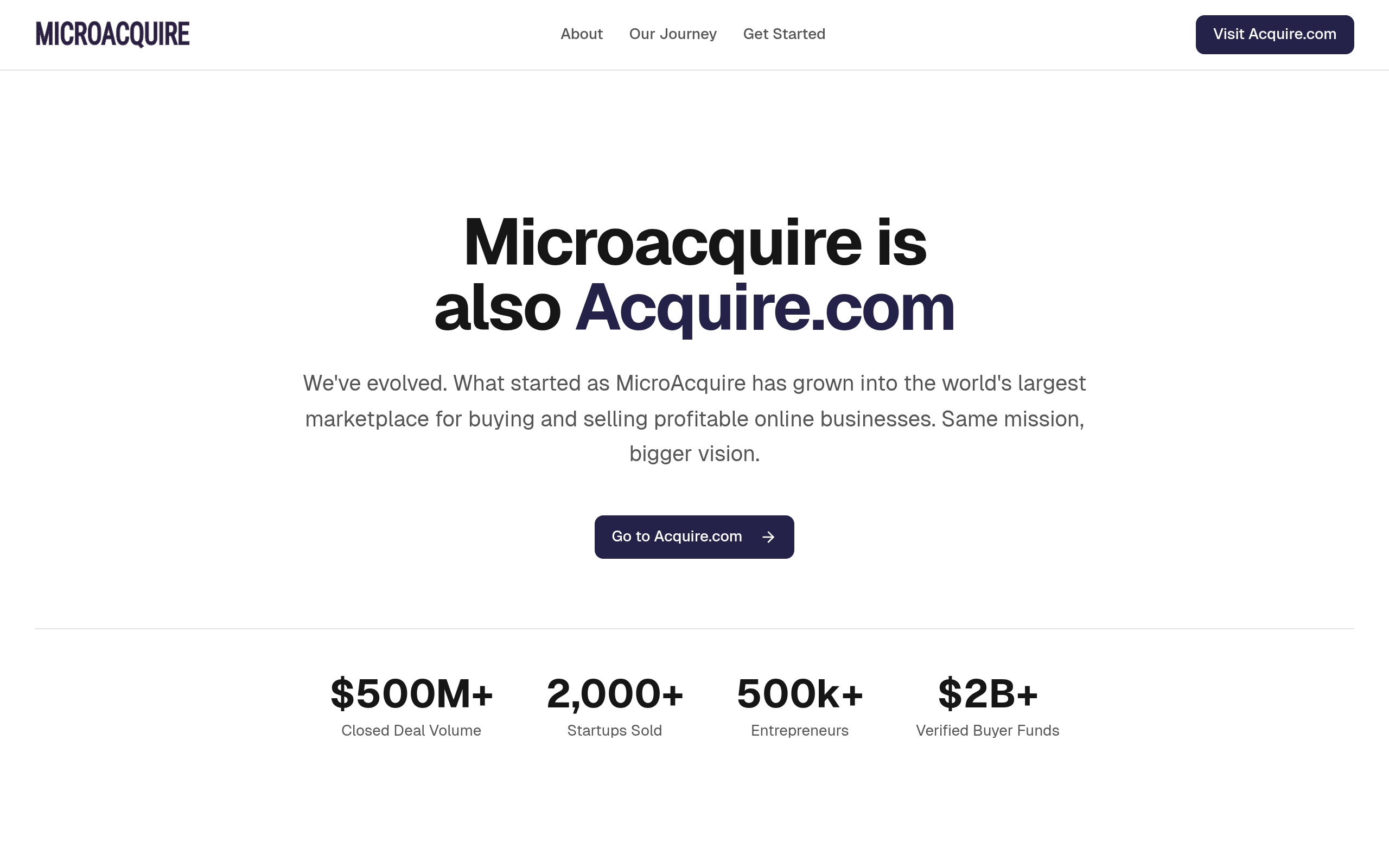
Acquire.com rebranded from MicroAcquire and has positioned itself specifically around startup and SaaS acquisitions, with a heavier focus on vetted founders and buyers than Flippa's open marketplace. It built a reputation among indie hackers and bootstrapped SaaS founders as a more founder-friendly alternative, with free listing options and a buyer-verification step before financial details are shared. The tradeoff is that "vetted" mostly refers to identity and intent, not an independent audit of the MRR figures a seller reports — buyers still need to run their own diligence on bank statements, Stripe dashboards, or payment processor exports. See Acquire.com.
GetAcquired
GetAcquired positions itself as a curated marketplace with a broker-assisted feel, aimed at sellers who want more hand-holding through the sale process — think listing optimization, buyer screening, and negotiation support — rather than a pure self-serve listing board. This suits first-time sellers who don't want to manage inbound buyer conversations themselves, but it typically comes with higher success fees than fully self-serve platforms, and deal velocity can be slower because of the added human layer. See GetAcquired.
Keyquire
Keyquire is a smaller, more focused marketplace that has carved out a niche among micro-SaaS and indie acquirers looking for smaller deal sizes than the flagship listings you'd see on Flippa or Acquire.com. Its smaller buyer pool means less competition for listings, which can mean better terms for buyers willing to do more of their own outreach and diligence work. See Keyquire.
Where TrustMRR fits as the verification-first marketplace

TrustMRR takes a different starting point: instead of asking sellers to upload a screenshot or self-report a number, it connects to live revenue sources so the MRR figure attached to a listing is verified continuously, not just checked once at listing time. For buyers, this collapses a big chunk of the diligence workload — you're not starting from "prove this number is real," you're starting from "here's the verified number, now evaluate churn, concentration, and growth quality." For sellers, a verified badge can shorten negotiation cycles because buyers spend less time challenging the topline.
The tradeoff is scale. TrustMRR's listing pool is smaller than Flippa's because verification takes friction out of trust but adds friction to listing. If you want the widest possible buyer or seller pool at any deal size, general marketplaces still win on raw volume. If you want a materially lower risk of the revenue number being wrong, a verification-first marketplace is the more defensible starting point, especially for buyers writing five- and six-figure checks on limited diligence time.
Where ChartMRR fits — the intelligence layer, not another marketplace
It's worth being precise here: ChartMRR is not a competing marketplace and it doesn't list startups for sale itself. It's a market intelligence layer built on top of verified TrustMRR revenue data. Where Flippa, Acquire.com, GetAcquired, and Keyquire are places you transact, ChartMRR is where you research before and after you transact — turning verified MRR into ranked charts, cohort comparisons, and shareable milestone cards.
Concretely, on ChartMRR's ranked charts you can filter tracked and for-sale startups by revenue band, growth trajectory, or sector, and build an acquisition shortlist without creating an account. You can compare two or more startups side by side using verified TrustMRR data — useful when you've narrowed a Flippa or Acquire.com search to three or four candidates and want a neutral second read on their revenue trend before you ask a broker for the P&L. You can also set a watch on a specific startup by email — no login, no dashboard — and get notified if its verified MRR moves meaningfully, which matters if a deal falls through today but the business is still worth tracking for six months.
The practical workflow most serious acquirers land on: source listings on Flippa, Acquire.com, GetAcquired, or Keyquire, verify the revenue claim via TrustMRR where available, and use ChartMRR's cohort compare and ranked charts to sanity-check the trajectory against comparable startups before making an offer. None of that requires ChartMRR to host the listing — it's the diligence and benchmarking layer around the marketplaces you already use.
Feature and process tradeoffs, scenario by scenario

Consider three buyer scenarios, since "best marketplace" genuinely depends on what you're solving for:
- You're a first-time buyer with $15,000–$50,000 to deploy. Flippa or Acquire.com's larger listing pools give you more shots on goal, but budget real time for verifying MRR yourself — request Stripe or bank exports directly rather than trusting a screenshot. A TrustMRR-verified listing, where available, removes that step and is worth prioritizing even if the asking multiple is slightly higher.
- You're an operator doing repeat acquisitions and need deal flow at volume. You likely need presence across multiple marketplaces simultaneously — Flippa and Acquire.com for volume, Keyquire for smaller off-radar deals — and a way to rank and compare candidates fast. This is exactly the gap ChartMRR's ranked charts and cohort compare are built for: filter across many tracked startups at once instead of tab-switching between marketplace search results.
- You're selling and want to prove your growth story, not just your current MRR. A revenue "career" that shows dated movement — not just today's number — is more persuasive to a serious buyer than a static one-time snapshot. ChartMRR's shareable milestone cards, built on TrustMRR verification, let founders publish a dated growth trajectory (e.g., "crossed $10k MRR," "18 months of consecutive growth") that a broker listing alone can't show.
Pricing and fee structures compared
Fee models differ meaningfully across these platforms and directly affect your effective purchase price or exit proceeds:
- Flippa: listing fees vary by tier, plus a success fee on closed transactions that scales down as deal size increases — check current rates directly, as Flippa periodically adjusts its fee schedule.
- Acquire.com: historically offered free basic listings with success fees charged on close, positioning itself as lower-friction for sellers testing the market before committing to a broker-assisted sale.
- GetAcquired: broker-style involvement typically means a higher percentage success fee in exchange for done-for-you buyer screening and negotiation support.
- Keyquire: smaller platform, generally lower competition for listings, with fee structures aimed at micro-deal sellers rather than seven-figure exits.
- TrustMRR: verification-first model where the value proposition is reduced diligence risk rather than raw fee savings — factor the time you save on manual verification into your total cost comparison.
- ChartMRR: free to explore. There's no account requirement to browse ranked charts or run cohort comparisons; providing an email is only needed if you want to watch a specific startup or subscribe to milestone updates.
Migration notes: moving between marketplaces

If you've listed on one marketplace and want to move or cross-list, most platforms don't restrict you from listing simultaneously elsewhere, but each requires re-uploading financials, screenshots, and business descriptions separately — there's no unified profile that follows you from Flippa to Acquire.com to GetAcquired. This is one reason verified data sources matter: if your revenue is already verified through TrustMRR, you're not re-proving the same number three times across three listing forms — you can reference the same verified figure in each listing's description. Buyers researching a listing that appears on multiple marketplaces can also cross-check consistency using ChartMRR's ranked charts, since a verified startup's TrustMRR-backed trajectory doesn't change depending on which marketplace is hosting the listing that week.
Decision framework: which marketplace should you use
Choose Flippa if you want the largest possible buyer or seller pool and are comfortable running your own revenue verification, or if you're transacting in categories beyond pure SaaS.
Choose Acquire.com if you specifically want a startup/SaaS-focused audience with buyer identity vetting and a founder-friendly listing experience, and you're willing to independently confirm financials.
Choose GetAcquired if you're a first-time seller who wants broker-style support through negotiation and prefers less hands-on marketplace management, and you can absorb a higher success fee for that convenience.
Choose Keyquire if you're targeting smaller micro-SaaS deals and want less competition from institutional buyers crowding out modest offers.
Choose TrustMRR-verified listings, wherever you find them, if your top priority is minimizing the risk that the headline MRR is wrong — this is the single highest-leverage diligence shortcut available right now for revenue verification.
Use ChartMRR alongside any of the above — not instead of them — when you want to shortlist, rank, and compare candidates using verified data before committing diligence hours, or when you want to track a startup's dated growth trajectory over time rather than relying on a single point-in-time listing snapshot. Start from the ranked charts or head to the ChartMRR homepage to see how tracked and for-sale startups compare.
Common mistakes buyers make across all of these marketplaces
Regardless of which marketplace you choose, the same handful of mistakes show up repeatedly in failed or regretted acquisitions. Buyers accept a revenue screenshot without requesting the underlying export. Buyers skip customer concentration checks and later discover 40% of MRR sits with two accounts. Buyers don't check whether "growth" in a listing description reflects a genuine multi-month trend or a single lucky month cherry-picked for the pitch. And buyers rarely check a startup's revenue history before the listing existed — a business that spiked to its current MRR three weeks before listing tells a very different story than one with eighteen months of steady, verifiable growth. This last point is exactly why dated movement matters more than a single current number, and it's the specific gap that ranked, historical revenue charts are built to close.
Frequently asked questions
Is ChartMRR a marketplace where I can buy a SaaS business?
No. ChartMRR doesn't list businesses for sale or facilitate transactions directly. It's a market intelligence layer that ranks and compares startups using verified TrustMRR revenue data, helping you build shortlists and benchmark candidates you find on marketplaces like Flippa, Acquire.com, GetAcquired, or Keyquire.
What does "TrustMRR-verified" actually mean?
It means the MRR figure attached to a startup has been checked against a live revenue source rather than accepted as a self-reported screenshot or export, reducing the risk that the headline number a seller advertises doesn't match reality.
Do I need an account to use ChartMRR's ranked charts?
No signup is required to explore rankings or filter tracked and for-sale startups at chartmrr.com/chart. An email is only needed if you want to watch a specific startup for changes or subscribe to milestone or newsletter updates.
Which marketplace has the lowest fees for sellers?
Fee structures change over time and vary by deal size on every platform listed here, so always check current published rates on Flippa, Acquire.com, GetAcquired, and Keyquire directly before assuming a low headline fee — success fees often scale down as deal value increases, which changes the comparison for larger exits.
Can I cross-list on multiple SaaS acquisition marketplaces at once?
Most platforms don't prohibit simultaneous listings elsewhere, but there's no shared profile — you'll re-enter financials and descriptions on each. Referencing a single TrustMRR-verified figure across listings keeps your numbers consistent everywhere you list.
How do I compare two startups I found on different marketplaces?
If both have verified TrustMRR data, you can run them through ChartMRR's cohort compare to view their revenue trajectories side by side, independent of which marketplace is hosting either listing.
Is a bigger marketplace always better for buyers?
Not necessarily. A larger pool like Flippa means more choice but more variance in listing quality and more manual verification work per candidate; a smaller, verification-first pool trades volume for reduced diligence risk per listing.
The right answer for most serious acquirers isn't picking a single winner among Flippa, Acquire.com, GetAcquired, Keyquire, and TrustMRR — it's sourcing broadly across them while verifying tightly, using ranked, dated intelligence to decide which candidates deserve your diligence hours. Explore the current rankings at ChartMRR's chart or start from the homepage to see how it fits into your acquisition workflow.
Key facts
- Flippa is the largest and oldest general-purpose marketplace covering SaaS, newsletters, and e-commerce listings.
- SaaS valuations are typically expressed as a revenue multiple, commonly 2x–5x ARR for smaller deals and higher for high-growth or AI-native products.
- A 15% MRR overstatement on a $40,000 ARR business at a 3.5x multiple equals roughly a $21,000 valuation error.
- TrustMRR is positioned as a verification-first SaaS marketplace where listed MRR is checked against a live billing data source rather than a static screenshot or export.
- Acquire.com, GetAcquired, and Keyquire are among the narrower marketplaces built specifically around recurring-revenue SaaS deals, as opposed to general asset marketplaces.
- ChartMRR functions as an intelligence layer on top of SaaS acquisition marketplaces, providing market comps and revenue benchmarking rather than hosting listings itself.
- Buyer risk in SaaS acquisitions has shifted from 'which marketplace has the most listings' to 'which marketplace provides defensible, verifiable revenue numbers before deposit.'
ChartMRR provides SaaS revenue benchmarking and market intelligence that helps buyers and sellers evaluate deals across marketplaces like Flippa, Acquire.com, and TrustMRR with verified, data-backed context.