
Picking from the best platforms to buy SaaS startups is less about which marketplace has the most listings and more about which one lets you trust the numbers behind those listings. Anyone who has spent a weekend scrolling through asking-price spreadsheets knows the real bottleneck isn't discovery — it's verification. A founder claiming $18K MRR on a screenshot is not the same as a founder with a dated, third-party-verified revenue history. This guide compares the marketplaces where SaaS acquisitions actually close — Flippa, Acquire.com, GetAcquired, Keyquire, and TrustMRR — and explains where a verified-data intelligence layer like ChartMRR fits into the due-diligence process.
What Buying a SaaS Startup Actually Requires
Before comparing platforms, it helps to separate the two jobs a buyer has to do: finding a deal and verifying it. Marketplaces solve the first problem — they aggregate sellers, standardize listing formats, and provide escrow or deal-closing infrastructure. None of them, by themselves, solve the second problem completely. Verification still depends on how rigorously a platform checks revenue claims, how current the data is, and whether a buyer can compare a target startup against peers before committing capital.
This is the lens we'll use throughout: for each marketplace, what's the ICP (who it's actually built for), what does it cost to transact, how strong is its revenue verification, and where do serious buyers still need a second layer of intelligence to avoid overpaying for a story instead of a business.
The Marketplace Landscape for SaaS Acquisitions
Here's how the five most-referenced platforms for buying SaaS and micro-SaaS businesses stack up in practice.
Flippa
Flippa is the largest and oldest general marketplace for buying and selling online businesses — websites, content sites, e-commerce stores, apps, and SaaS products all sit side by side. Its scale is a strength (thousands of active listings at any time) and a weakness (SaaS deals are mixed in with a much broader, more variable-quality pool). Flippa offers its own verification badges and due-diligence tooling for sellers who opt in, but because the platform spans so many business models, a buyer specifically hunting for verified-MRR SaaS deals has to filter aggressively. Flippa fits generalist buyers doing high-volume deal flow across asset types, less so specialists who only want SaaS with clean, audited revenue history.
Acquire.com (formerly MicroAcquire)
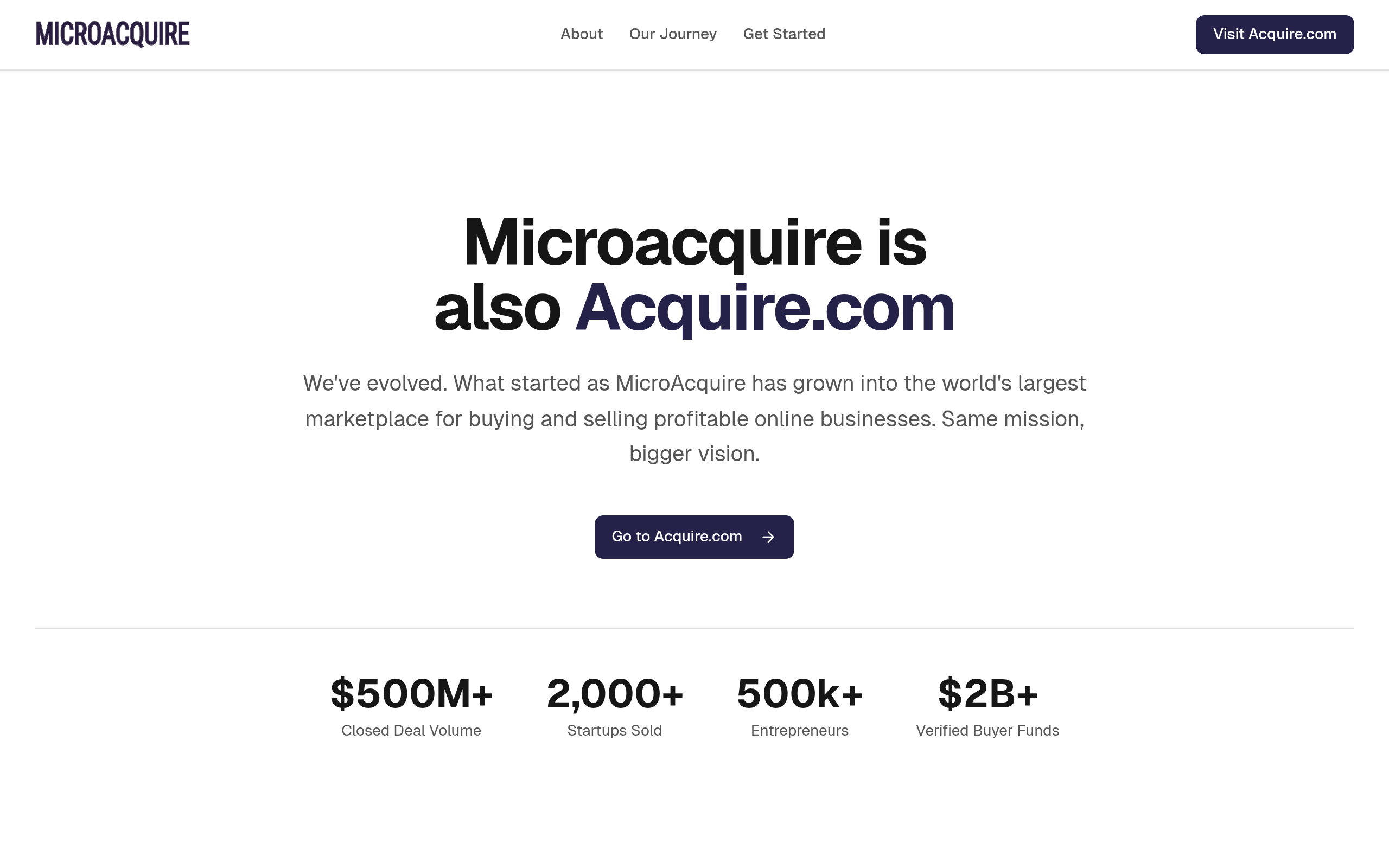
Acquire.com, the rebrand of MicroAcquire, is purpose-built for startup and SaaS acquisitions rather than general online businesses. Its ICP is founders selling bootstrapped or lightly-funded SaaS companies to first-time acquirers, indie operators, and small PE-style buyers. Compared to Flippa, listings skew more technical (recurring-revenue software rather than content or affiliate sites), and the platform has invested in structured deal rooms and buyer verification. The tradeoff: revenue figures on listings are still largely self-reported at the point of first contact, so buyers still need to independently confirm MRR trajectory before signing an LOI.
GetAcquired
GetAcquired positions itself as a curated alternative for SaaS and digital business sales, often with more concierge-style matching between buyers and sellers. It fits buyers who want a smaller, more curated deal flow and more hands-on introductions rather than sifting through an open marketplace. The smaller listing volume means less noise, but also fewer data points to benchmark a given startup's growth against a comparable cohort.
Keyquire
Keyquire is a newer entrant targeting the same buy-side audience — indie hackers and small acquirers looking for SaaS and content businesses in a defined price range. Like GetAcquired, its value is in a leaner, more targeted deal flow rather than raw listing volume. Buyers evaluating Keyquire listings should expect to do the same independent revenue verification work they would on any emerging marketplace with a shorter track record.
TrustMRR
TrustMRR is the acquisition marketplace built around verified revenue from day one — sellers connect their billing or analytics data so the MRR figures attached to a listing are dated and confirmed rather than self-reported screenshots. This is the direct comparison point to Flippa, Acquire.com, GetAcquired, and Keyquire: instead of asking buyers to trust a claim and then verify it later in diligence, TrustMRR bakes verification into the listing itself. For buyers whose biggest risk is inflated or cherry-picked revenue numbers, this changes the order of operations — verification happens before you spend time on a deal, not after.
Where Verified Revenue Data Changes the Buying Decision

Here's a scenario that plays out constantly in SaaS acquisitions: a buyer finds a promising listing on a general marketplace, sees a growth chart in the data room, and starts negotiating based on that trajectory. Weeks later, deeper diligence reveals the "growth" was a one-time annual prepay spike, or that churn was quietly rising under a plateaued top-line number. The listing wasn't necessarily fraudulent — it was just incomplete. This is exactly the gap that verified, dated revenue tracking is meant to close, and it's why buyers increasingly want a second, independent view of a startup's numbers before they get deep into a deal room.
This is where ChartMRR comes in — not as another marketplace, but as the market intelligence layer built on top of TrustMRR's verified revenue data. ChartMRR doesn't list startups for sale directly and it doesn't broker transactions; it turns verified TrustMRR revenue into ranked charts, shortlists, and cohort comparisons so buyers can evaluate a target's trajectory against real peers before they ever open a deal room.
ChartMRR as the Intelligence Layer on Top of TrustMRR
Think of the buying workflow in two stages. Stage one is discovery and shortlisting — deciding which of the dozens of SaaS businesses currently for sale are worth a serious look. Stage two is deal-specific diligence — verifying the specific numbers behind the one or two finalists you're negotiating with. ChartMRR is built almost entirely for stage one, using TrustMRR's verified data as its foundation.
Concretely, that means:
- Ranked TrustMRR charts — startups ordered by verified MRR, growth rate, or momentum, so you can see where a target actually sits among peers rather than trusting its own framing of "fast-growing."
- Acquisition shortlists — a filtered view of startups that are actively for sale, cross-referenced against verified revenue rather than asking-price marketing copy.
- Cohort compare — putting two or more startups side by side on verified metrics, which is useful when you're deciding between, say, three similarly-priced dev-tools SaaS companies with different growth shapes.
- Shareable milestone cards — dated proof points (first $10K MRR, first $50K MRR) that let founders and buyers communicate progress without a screenshot going back and forth over email.
- Watches and alerts — an optional email-based way to track a specific startup's movement over time instead of checking back manually.
None of this requires an account or setup. You can explore the ranked chart and filter by sector, growth rate, or for-sale status immediately, compare two or more startups on verified data, and only provide an email if you want to watch a specific company or receive milestone updates. That's a meaningfully different starting point than opening a marketplace and manually cross-checking every listing's revenue claim yourself.
Feature & Ops Tradeoffs: What Actually Matters in Practice

Consider a buyer with roughly $150K to deploy who is comparing three SaaS listings sourced from Acquire.com, Flippa, and TrustMRR respectively, all claiming similar ARR. On Acquire.com and Flippa, the buyer's first move is typically to request bank statements, Stripe exports, or analytics dashboard access — a manual, seller-dependent process that can take days and is only as good as what the seller chooses to share. On TrustMRR, the revenue history is already dated and verified at the listing level, which shifts the buyer's early-stage work from "prove this number is real" to "understand why this number moves the way it does."
That second question — the "why" behind the trajectory — is where ChartMRR's cohort compare and ranked charts add value regardless of which marketplace the listing originated from. If a target startup is ranked in the bottom third of its sector cohort for growth despite a high asking-price multiple, that's a data point no single listing page will surface on its own. Conversely, a startup showing consistent verified MRR movement across many months — visible as a milestone trail — is a very different risk profile than one with a single recent spike.
The practical tradeoff: general marketplaces like Flippa give you the largest raw deal flow but the least standardized verification; purpose-built SaaS marketplaces like Acquire.com, GetAcquired, and Keyquire narrow the field but still lean on self-reported figures at first contact; TrustMRR bakes verification into the listing itself; and ChartMRR sits above all of that as the place to rank, shortlist, and compare before you commit diligence hours to any single deal.
Pricing, Access, and Migration Notes
Marketplace economics vary by model. Flippa and Acquire.com typically monetize through a mix of listing fees, success fees on closed deals, and premium buyer/seller tiers — check each platform's current pricing directly since these terms change. GetAcquired and Keyquire, being smaller and more curated, often price around matching or introduction services rather than pure listing volume. None of these require a specific "migration" in the traditional software sense — you're not moving data between them, you're choosing where to source and close a deal.
ChartMRR's access model is worth calling out because it's simpler than any marketplace: there's no account creation or setup required to browse the ranked chart or run a cohort comparison. Email is only needed if you want to watch a specific startup for movement or opt into milestone/newsletter updates. Rankings reflect standing among startups ChartMRR tracks via TrustMRR's verified data — it's not a statement about every SaaS business on the market, only the tracked and verified set.
Decision Framework: Choosing the Right Platform for Your Acquisition

Choose Flippa if you want the widest possible deal flow across business types and are comfortable running your own verification process on every listing, including content sites and e-commerce alongside SaaS.
Choose Acquire.com if you specifically want startup and SaaS-focused listings with more structured deal rooms, and you're prepared to independently confirm revenue figures before an LOI.
Choose GetAcquired or Keyquire if you prefer a smaller, more curated set of introductions over browsing a large open marketplace, and deal volume matters less to you than fit.
Choose TrustMRR as your marketplace if verified, dated revenue at the listing level is your top priority and you'd rather start diligence from a confirmed baseline than a self-reported one.
Use ChartMRR alongside whichever marketplace you choose if you want to rank a target against its peer cohort, compare multiple shortlisted startups side by side on verified metrics, or track a startup's MRR movement over time before making an offer. It's the layer that turns "this listing looks good" into "this listing ranks well against comparable, verified startups" — see how to identify promising startups for acquisition and why verified MRR matters in acquisitions for deeper walkthroughs of this process.
A Realistic Buyer Workflow Using Multiple Platforms Together
In practice, the buyers who close the best deals rarely rely on a single platform end to end. A typical workflow looks like this: source candidate listings from Acquire.com, Flippa, or TrustMRR directly; cross-reference the strongest candidates against ChartMRR's ranked chart and cohort compare to see how they stack up on verified revenue against similar-stage peers; shortlist two or three finalists and set a watch/alert on each to track MRR movement over a few weeks before committing; then move into deal-specific diligence — bank statements, customer concentration, churn cohorts — only on the finalists that hold up under that broader comparison. This sequencing saves the most expensive resource in an acquisition search: your own diligence hours. For more on structuring this search, see how to find verified SaaS startups for sale and MRR data analysis for startup investors.
Common Mistakes Buyers Make Across These Platforms
The most frequent error isn't picking the "wrong" marketplace — it's treating any single listing's revenue chart as the full picture. Sellers on every platform, including the more curated ones, have an incentive to present their best few months. A second common mistake is skipping cohort context entirely: a 15% month-over-month growth rate sounds impressive until you see that every comparable startup in that sector is growing at 25%. Finally, buyers often under-invest in tracking movement over time — a snapshot taken once during negotiation misses whether momentum is accelerating or already decelerating heading into close. Milestone tracking and watch alerts exist specifically to close that gap; you can see how founders themselves use this kind of tracking in how to track startup revenue movement.
Frequently Asked Questions
Is ChartMRR a marketplace where I can buy a SaaS startup directly?
No. ChartMRR is a market intelligence layer built on top of TrustMRR's verified revenue data. It provides ranked charts, shortlists, and cohort comparisons to help you evaluate startups, but the actual acquisition marketplace and transaction infrastructure is TrustMRR (and, if you're sourcing elsewhere, platforms like Acquire.com, Flippa, GetAcquired, or Keyquire).
Do I need to create an account to use ChartMRR?
No account or setup is required to browse the ranked chart or filter startups. You only provide an email if you choose to watch a specific startup for movement alerts or opt into milestone/newsletter updates.
How is TrustMRR's verified revenue different from a self-reported MRR screenshot?
TrustMRR connects to a seller's actual billing or analytics data so the revenue history attached to a listing is dated and confirmed rather than a manually assembled export or screenshot, which is harder to independently audit and easier to selectively present.
Which marketplace has the most SaaS-specific listings?
Acquire.com (formerly MicroAcquire) and TrustMRR are both built specifically around startup and SaaS acquisitions. Flippa carries SaaS listings too, but within a much broader mix of website, content, and e-commerce businesses, so filtering takes more effort.
Can ChartMRR help me compare a listing from Flippa against one from TrustMRR?
ChartMRR's rankings and cohort compare are built from startups tracked via TrustMRR's verified data, so its direct comparisons work best within that tracked set. It's still useful indirectly — you can use the verified peer benchmarks on ChartMRR to judge whether a Flippa or Acquire.com listing's claimed growth rate looks reasonable relative to comparable, verified SaaS businesses.
What should I check before making an offer on any SaaS listing?
At minimum: dated revenue history (not just a current snapshot), churn and customer concentration, how the startup ranks against comparable peers in growth rate, and whether recent months show acceleration or deceleration. Milestone cards and watch alerts on ChartMRR's milestone tracker can help confirm the trajectory before you commit to a deal room.
Buying the right SaaS startup starts with sourcing from a marketplace that fits your deal size and risk tolerance — Flippa, Acquire.com, GetAcquired, Keyquire, or TrustMRR — but it ends with confidence that the numbers you're paying a multiple on are real, dated, and hold up against comparable startups. Explore the ranked TrustMRR chart or start at ChartMRR's homepage to shortlist and compare verified SaaS startups before your next acquisition search.
Key facts
- The main marketplaces for buying SaaS startups are Flippa, Acquire.com, GetAcquired, Keyquire, and TrustMRR.
- Flippa is the largest and oldest general marketplace, listing websites, content sites, e-commerce stores, and SaaS businesses together.
- Marketplaces solve deal discovery — aggregating sellers and standardizing listings — but do not fully solve revenue verification on their own.
- Buyer due diligence for SaaS acquisitions depends on three factors: how rigorously revenue claims are checked, how current the data is, and whether the buyer can benchmark the target against peers.
- ChartMRR functions as a verified-revenue intelligence layer that sits on top of marketplace listings, helping buyers shortlist and vet SaaS acquisition targets faster.
- A common mistake in SaaS acquisitions is relying on self-reported MRR screenshots instead of dated, third-party-verified revenue histories.
- Serious SaaS buyers often use multiple platforms together in a workflow: one for sourcing deals, another for verifying and benchmarking revenue data.
ChartMRR is a revenue intelligence platform that provides verified SaaS financial data, helping buyers and investors vet acquisition targets and benchmark performance beyond self-reported revenue claims.